Underwater welding is done in two ways. In wet welding, the diver welds directly in the water with a waterproofed coated electrode: it's fast and cheap, but the metallurgical quality is lower. In hyperbaric dry welding a sealed enclosure is installed around the joint, the water is displaced, and welding is done in a gas atmosphere, with quality comparable to welding on the surface.
Underwater welding is the specialty that draws the most attention in all of commercial diving, and also the one that generates the most noise. It's worth starting with the basics: it isn't a separate profession from diving, it's a skill a commercial diver can add to their repertoire. First you're a diver; then, a diver who welds.
And once there, there are two techniques that share little more than the name. Understanding how they differ explains why one is used for one-off repairs and the other for critical structural joints that have to last decades.
Wet welding: welding in the water
In wet welding the diver welds directly while submerged, with no barrier between the arc and the water. The usual process is shielded metal arc welding —SMAW— with electrodes specifically waterproofed for underwater use.
The arc works because it generates a gas bubble produced by the breakdown of the electrode coating and of the water itself. That bubble momentarily isolates the weld pool from the surrounding water and allows the metal to be deposited. The diver works inside that cloud of bubbles, with reduced visibility and relying heavily on feel.
The metallurgical problem
Water cools the metal very quickly. That accelerated quenching favours the formation of hard, brittle microstructures in the heat-affected zone. Add to that hydrogen: the dissociation of water in the arc introduces hydrogen into the deposited metal, which is the classic mechanism behind cold cracking.
The result is a weld that can be perfectly valid for what it's needed for, but which has lower toughness and more propensity to crack than an equivalent weld made dry. It isn't a workmanship defect, it's process physics.
Where it's used
Wet welding is the right tool when what's needed is a quick repair, a temporary reinforcement, fitting sacrificial anodes, joining non-structural elements, sealing cracks or salvage work. It's cheap, requires no prior installation and can start within hours.
Industry standards recognise this reality and set out classes of underwater welding with different requirements depending on how critical the joint is, so a well-executed, correctly classified wet weld is a legitimate solution, not a bodge.
Hyperbaric dry welding
The approach here is the opposite: if water is the problem, remove the water. A sealed enclosure —a habitat— is built and installed around the area to be welded, gas is injected at the ambient pressure corresponding to the depth, and the water is displaced. The diver enters that enclosure, comes out of the water and welds dry.
The internal pressure matches that of the surroundings, hence 'hyperbaric'. The processes used are the same as on the surface: shielded metal arc, gas-shielded arc or tungsten electrode arc, selected according to the material and requirements.
Why the quality is higher
Removing the water eliminates the sudden cooling and drastically reduces hydrogen pickup. The piece can be preheated, the interpass temperature controlled, and post-weld heat treatment applied. The result is joints whose mechanical properties come close to those of a weld made in a workshop.
What's more, in dry conditions the joint can be properly inspected: radiography, ultrasonics, magnetic particle testing. That inspection capability is what allows the joint to be certified for permanent structural service.
What it costs
All of that has a price. A habitat has to be designed and built to fit the specific geometry of the joint, transported, installed underwater with precision, sealed, supplied with gas with fume extraction managed, and a team kept working around it for days or weeks. A hyperbaric dry intervention is an engineering project, not a task.
Where it's used
It's reserved for what justifies it: repair of risers and subsea pipelines in service, repair of structural nodes on fixed platforms, pipe tie-ins and any joint whose failure would have serious consequences. It's common in the North Sea and in the major offshore fields, where the infrastructure is ageing and repairing it is much cheaper than replacing it.
Practical comparison
Summed up in what matters on site: wet welding is set up in hours and costs little, hyperbaric welding is set up in days or weeks and costs a lot. Wet welding gives quality limited by the process, hyperbaric gives certifiable quality. Wet welding is for repairs and secondary elements, hyperbaric for critical structural joints.
There's a lesser-known third, intermediate option: dry welding at atmospheric pressure, where the enclosure is kept at one atmosphere instead of ambient pressure. It gives the highest quality possible but requires an enclosure able to withstand the full pressure difference, which limits it to moderate depths and very specific cases.
Safety: the risks specific to it
Welding underwater adds risks that don't exist in ordinary diving. The main one is electrical: the work is done with direct current and a circuit that passes through a conductive medium. Control rests with the surface operator via a safety switch that only closes the circuit when the diver asks for it and opens it as soon as the pass is finished. The diver must never be on a closed circuit without actively welding.
The second risk is gas build-up. The arc generates hydrogen and oxygen, and if that mixture gets trapped in an enclosed space —inside a structure, under a plate, in the roof of a compartment— it can cause a deflagration. Structures are ventilated and welding in confined spaces without gas extraction is avoided.
On top of that are the usual welding risks: arc radiation to the eyes, burns, fumes. In hyperbaric dry welding there are also the risks of working in an artificial atmosphere, with control of gas quality and temperature inside the habitat, and the risk of fire within an enclosed space.
Equipment and manufacturers
The specific equipment includes waterproofed electrodes, electrode holders designed for underwater use with reinforced insulation, oxy-arc cutting equipment and the safety switches. Broco is one of the best-known manufacturers of underwater cutting and welding equipment, and Hydroweld is a common reference for wet welding consumables. You can see more categories in equipment.
How you get to welding underwater
The order matters and there are no shortcuts. First, commercial diving training at a recognised centre and a valid certification, which is what the guide to how to become a commercial diver. Second, real competence as a welder: the logical thing is to learn to weld well on the surface and qualify before attempting it submerged.
Third, specific training in underwater welding, which many schools offer as a supplementary module. And fourth, procedure qualification for the specific job: on serious projects it's not enough to know how to weld, you have to be qualified for that procedure, that material and that position.
It's one of the specialties with the best demand within commercial diving, precisely because it requires mastering two trades at once. The schools that teach these modules are in the directory of schools, and the applicable diving certifications in certifications.
Frequently asked questions
Is wet welding poor quality?
It isn't poor, it's different. The rapid cooling from the water and hydrogen pickup reduce toughness compared with an equivalent dry weld. Industry standards recognise this and classify underwater welds by grade, so a well-executed wet weld is valid for the applications it's suited to.
Can a diver be electrocuted while welding?
The risk exists, which is why the circuit is controlled by the surface operator with a safety switch that only closes when the diver requests it. Direct current is used, along with reinforced-insulation equipment and strict procedures. With those controls in place the risk is kept under control.
How long does it take to train as an underwater welder?
There's no single figure. You need commercial diving training, proven competence as a surface welder, and then the specific underwater welding module. Adding up the three stages plus the time needed to gain real experience, two to three years is realistic.
Why isn't hyperbaric dry welding always used?
Because of cost and time. It requires designing and building a habitat for the specific geometry of the joint, installing it underwater, sealing it and sustaining the operation for days or weeks. It's only justified when the joint is structural and critical.
What gases are breathed inside a hyperbaric habitat?
It depends on the depth. At moderate depths air or nitrox can be used; at greater depths helium mixes are used. The atmosphere is continuously monitored for composition, temperature and humidity, and ventilated to clear welding fumes.
Published 20 August 2026 · By Arthur More, professional saturation diver
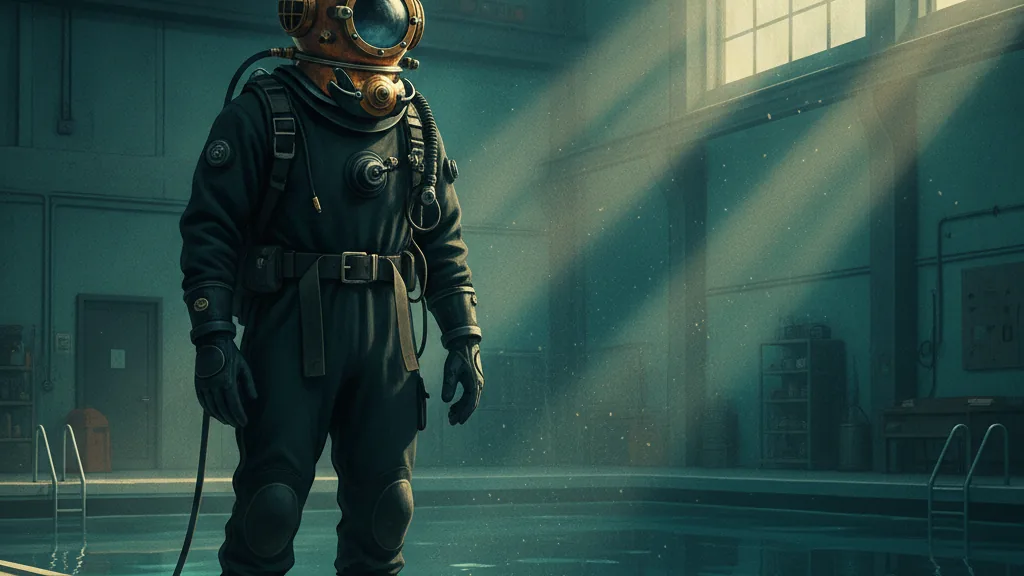
Photo: PiktourUK · CC BY via Openverse
This article is part of our in-depth guide to underwater welding: the pay, the training and the myth — the complete picture, with sources.
This article is part of our in-depth guide to underwater welding: the pay, the training and the myth — the complete picture, with sources.
This article is part of our in-depth guide to underwater welding: the pay, the training and the myth — the complete picture, with sources.
This article is part of our in-depth guide to underwater welding: the pay, the training and the myth — the complete picture, with sources.