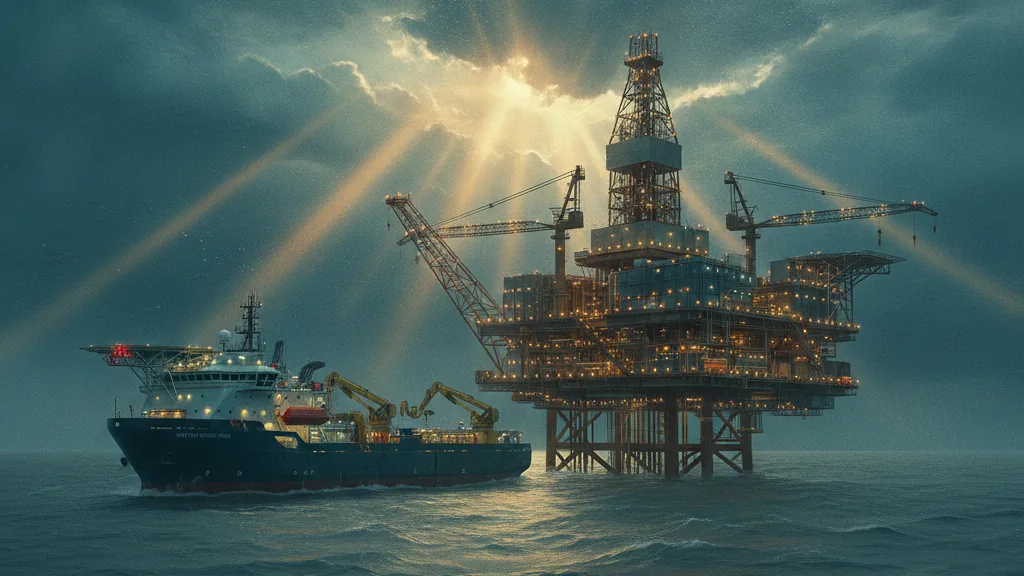
The North Sea is the heart of European saturation diving thanks to a combination of factors: Aberdeen as a hub for subsea services, a stable labour agreement (the ODIA deal), decades of mature oil infrastructure, and growing demand for maintenance and decommissioning that keeps specialist employment going all year round.
When someone asks where a saturation diver's work is concentrated in Europe, the answer almost always points to the same place: the North Sea. That's no coincidence, and it's not just a matter of geology. It's the result of half a century of offshore investment, a very dense industrial ecosystem, and a labour framework that has professionalised the trade like almost nowhere else in the world. In this guide we look at why this basin earned the title of saturation capital, and what that means for anyone who wants to work there.
Aberdeen, the epicentre of European offshore diving
Aberdeen, in north-east Scotland, has been known for decades as the energy capital of Europe. Since the seventies, when large-scale exploitation of the North Sea got under way, the city became the logistics base for operators, subsea contractors, inspection companies and equipment suppliers. That concentration is exactly what makes it so relevant to commercial diving: it's not enough for there to be oil under the sea, you need a whole chain of services capable of maintaining dive support vessels, saturation systems, hyperbaric chambers and qualified personnel.
Aberdeen and its surrounding area are home to offices of the big subsea contractors, port terminals, helipads out to the platforms, and training centres. For a diver, that translates into something very concrete: mobilisation processes, courses, medicals and interviews all tend to gravitate around this area. If you want to understand the full map of regions where saturation divers get hired, we have a dedicated guide to where saturation diving work happens around the world.
What the ODIA agreement is and why it matters
One of the features that sets the North Sea apart from other markets is the existence of a solid collective agreement. The Offshore Diving Industry Agreement, known by its acronym ODIA, is the agreement that governs divers' conditions in the British sector. It's negotiated between the diving contractors that belong to IMCA (the international marine contractors association) and the RMT and Unite unions, and it's reviewed periodically.
It's hard to overstate how important the ODIA is. In many parts of the world, a diver's conditions depend almost entirely on whichever contractor happens to be hiring and on the country where the contract is signed. In the North Sea, by contrast, there's an agreed common floor that gives predictability to both the company and the worker.
Pay, day rates and bonuses
The agreement sets minimum day rates for the different roles (air diver, bell diver, supervisor) and defines supplements, such as the depth bonuses applied on saturation jobs. Since these are figures that get updated over time, it's always worth checking the current version before signing. To get a sense of ranges and how the trade's pay is structured, check our page on how much a diver earns, where we explain the difference between a working day, a paid rest day and add-ons.
Rotations and working conditions
The ODIA also covers practical day-to-day offshore matters: rotation periods, rest breaks, medical cover and conditions within the saturation system. The work is organised into campaigns: the diver goes offshore, stays pressurised in the hyperbaric complex for days or weeks, carries out their jobs on the seabed, and then goes through decompression before returning ashore. This predictability in the rotations is one of the reasons many professionals regard the North Sea as a benchmark market for building a career.
A mature sea: from oil to decommissioning
The North Sea is a mature basin. Many of its fields have been in production for decades and have entered a natural decline phase. Far from meaning the end of underwater work, this maturity has opened up two major fronts of activity that keep divers in employment.
The first is maintenance. Ageing infrastructure needs inspections, repairs, component replacement and constant monitoring of structural integrity. The older an asset gets, the more care it needs, and a good part of that work can only be done with human intervention underwater.
The second front, currently booming, is decommissioning. Removing platforms that have reached the end of their working life, cutting and recovering structures, plugging wells and cleaning up the seabed is a complex operation that combines heavy engineering with precision diving. In a region with so many legacy installations, decommissioning has become a significant source of work for the next decade, and it explains why demand for qualified divers hasn't disappeared despite declining production.
On top of that comes the growth of offshore wind. Although much of that sector relies on remotely operated vehicles, the experience and logistics built up in the North Sea mean many offshore diving professionals and companies are finding new opportunities in the energy transition.
Depths and technology
A good part of the North Sea's fields sit at working depths of around 90 to 150 metres, a range where saturation diving is the right technique. Above those depths, ROVs (remotely operated vehicles) take over, handling inspection tasks and light work at greater depth. This coexistence between divers and underwater robotics is now the norm: they don't compete, they complement each other depending on depth, the complexity of the job and cost. If you want to understand exactly what this technique involves, start with our guide on what a saturation diver is.
The key employers of the North Sea
The web of contractors operating in the basin is broad and has been through numerous mergers and rebrands over the years. Among the big names in subsea and offshore diving that have historically worked in the region are contractors like Subsea7, Boskalis, TechnipFMC and DOF, alongside specialist inspection and services companies that support operations. The landscape keeps evolving, with acquisitions and reorganisations redrawing the map every few years.
For the diver, what matters is knowing there's a limited number of companies with real capacity to run saturation campaigns, and that reputation, safety and certifications carry as much weight as availability. In our company directory directory we bring together contractors and operators in the sector so you can get your bearings on who operates where and who to send an application to.
How to get into the North Sea market
Working in North Sea saturation isn't a starting point, it's a goal. The usual path is to train first as a commercial diver, get a recognised certification, build up experience in air or bell diving and, only after that, make the jump to closed bell. The British sector requires the HSE commercial diving qualification for saturation work, one of the trade's benchmarks internationally.
If you're starting from zero, the logical route is to first understand how to train as a commercial diver and what qualifications are required in each country. From there, racking up days, keeping your medical record in good shape and building a network of contacts are the ingredients that open the door to saturation mobilisations. The North Sea rewards persistence: it's demanding on requirements, but it's also one of the most structured and professional environments a diver can find.
Frequently asked questions
Why is the North Sea considered the capital of saturation diving?
Because of the concentration of mature offshore infrastructure, a stable labour framework through the ODIA agreement, an underwater services industry established in Aberdeen, and growing demand for maintenance and decommissioning work.
What is the ODIA agreement?
The Offshore Diving Industry Agreement is the British sector's collective agreement, negotiated between contractors that are IMCA members and the RMT and Unite unions. It sets minimum day rates, depth bonuses and rotation conditions, and it's updated periodically.
Can you start saturation diving directly in the North Sea?
It's not usual. You first need recognised commercial diving certification, and after that, experience as an air or bell diver. Saturation comes after building up days and completing specific closed bell training.
What depths does work happen at in the North Sea?
Many fields sit between roughly 90 and 150 metres, within the typical range for saturation diving. At greater depths, the work is taken on by remotely operated vehicles (ROVs).
Does decommissioning create jobs for divers?
Yes. Removing platforms, cutting structures and cleaning up the seabed requires underwater intervention. In a mature basin like the North Sea, decommissioning is a growing source of work alongside maintenance.
What certification do I need to work in British waters?
In the United Kingdom sector, the HSE commercial diving qualification is required for closed bell (saturation) work, recognised internationally. Other equivalent certifications may require conversion depending on the contractor and the operator.
Published 10 August 2026 · satdiver.com



Photo: infomatique · CC BY-SA via Openverse