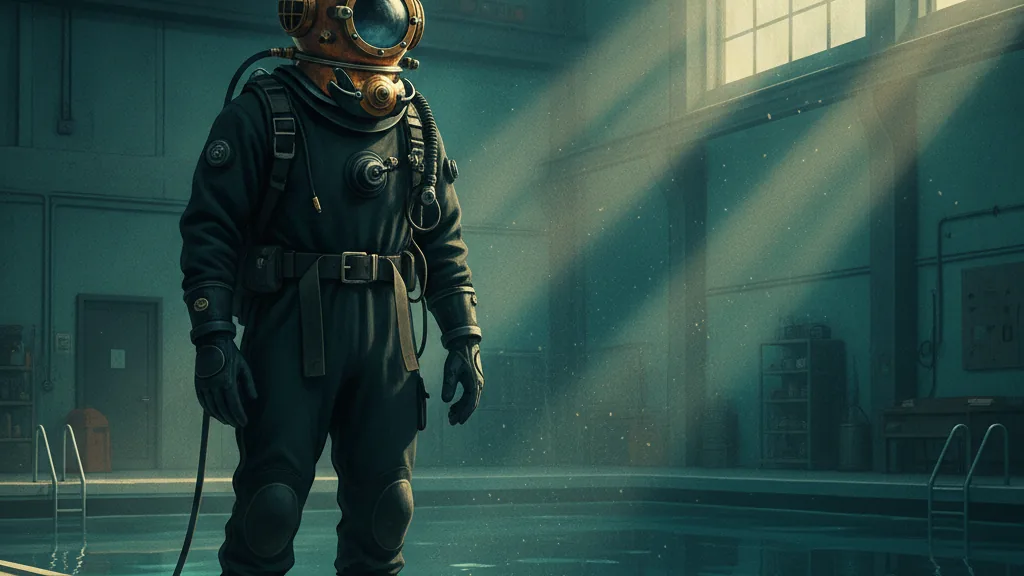
To get started in commercial diving with no experience you need to pass a medical fitness examination, enrol on a surface-supplied diving course with a recognised certification (HSE, ADCI or an equivalent compatible with IMCA), land your first inshore jobs and build up logged dives. You don't need to be a recreational diver, but you do need to be healthy and committed.
Commercial diving draws a lot of people in for the pay and the life away from a desk, but it also raises doubts: can you get in from a standing start? The short answer is yes. Almost every serious school trains people who have never dived professionally before. What makes the difference isn't your history underwater, but your health, your tolerance for hard work and your commitment to following an orderly route. This guide sets out that route step by step, with real requirements and no easy promises.
What "no experience" means in commercial diving
The term is worth clarifying. "No experience" doesn't mean you turn up with no preparation at all: it means you haven't worked before as a commercial diver. The industry draws a clear line between recreational diving (sport diving on scuba) and commercial diving (industrial underwater work with surface-supplied gas, tools and strict procedures). Holding a recreational qualification can help you feel at ease in the water, but it doesn't substitute for commercial training and gives you no formal edge in hiring.
What you do need before you start is decent physical condition, confident swimming, and a realistic attitude. It's a trade with long shifts, bad weather, weeks away from home and a safety dimension that allows no shortcuts. If that suits you, a lack of prior experience is an obstacle you can perfectly well overcome.
Step 1: Pass the medical fitness examination
Before investing in a course, pass the commercial diving medical examination. It's the first and most important filter: without a current fitness certificate you can't enrol at most schools, or work afterwards. In the United Kingdom it's signed off by an examining doctor approved by the HSE (Health and Safety Executive); other countries have equivalent roles recognised by the local authority or by standards such as IMCA's.
The examination assesses the heart, lungs, nervous system, ears and musculoskeletal system, among other things, because pressure and gases put demands on the body that don't exist on land. It's an annual examination, so passing it once isn't enough. Do it first: finding out after the course that you're not fit would be a huge waste of time and money.
Step 2: Choose a course with a recognised certification
This is where a lot of beginners go wrong. Not all courses carry the same weight: what matters is that the certificate is accepted by companies in the region where you want to work. Before you pay, check which qualification employers in your target market ask for, and choose a school whose certificate meets that standard.
The bodies you'll keep coming across
- HSE (United Kingdom): Health and Safety Executive qualifications, such as surface-supplied diving, are a classic reference point in Europe and the North Sea.
- ADCI (United States): the Association of Diving Contractors International issues the well-known ADC card and sets standards widely used across the Americas.
- IMCA: the International Marine Contractors Association isn't a school, but the association that sets much of the offshore standard followed by diving companies. Having training compatible with its criteria opens doors on international projects.
There are also national bodies, such as the Diver Certification Board of Canada, and equivalences between countries. The rule doesn't change: choose the certificate that opens the doors where you want to work. You can go deeper into the options and how they're recognised across borders in our guide to certifications, and compare schools in the directory of schools.
Step 3: Take the surface-supplied diving course
The first professional course isn't saturation or exotic gas mixes: it's surface-supplied diving, with gas fed from the boat or the quay. It's the foundation the whole career is built on. In these weeks of training you'll learn to handle the helmet and the umbilical, communicate with the supervisor, use underwater tools, work in zero visibility, and follow the safety and decompression procedures that define the trade.
How long it takes varies by country and level, from a few weeks to several months if you string modules together. It's intensive, physically demanding training. Use that time to ask instructors about the real state of the market and how former students found work: that information is worth as much as the certificate itself. If you want the full picture of the training route, check our guide to how to train as a commercial diver.
Step 4: Land your first inshore jobs
With the certificate in hand comes the part nobody hands you for free: the first job. Almost nobody jumps straight onto an offshore platform. The usual route is inshore — that is, coastal or inland-water work: ports, marine civil works, inspections, infrastructure maintenance, dams, reservoirs or fish farms. These are closer-to-home projects, with demanding days and modest pay compared with offshore, but they're the way in.
To land them, put together a clean CV with your certificate and your medical, contact local contractors and agencies, and make yourself available to start out on basic tender or junior diver tasks. Persistence matters more than luck: this sector hires a lot on recommendation, so every job done well generates the next one. You'll find contractors and agencies in the directory of companies and job listings in the empleo.
Step 5: Build up hours, dives and reputation
A commercial diver's most valuable asset is their logbook: the documented record of every dive, depth, task and hours worked. That record is what contractors look at before trusting you with bigger jobs. At the start, almost any project that adds logged experience is worth taking, even if it isn't the ideal one.
As you build up dives and prove your reliability, two paths open up: specialising (underwater welding, NDT inspection, ROV work, use of hydraulic tools) or making the jump to offshore in the North Sea, the Gulf of Mexico, Brazil, the Middle East or Southeast Asia. Only after years of experience with air and wet bell diving does it make sense to consider the course in saturation diving, the best-paid and most demanding specialisation in the sector.
Real requirements and costs to plan for
Putting figures and facts on the table, here's what it usually takes to get started:
- Salud: a current fitness medical, renewed every year.
- Swimming: confident swimming ability; many schools require passing a minimum test.
- Age: being an adult; there's no strict upper limit as long as you pass the medical examination.
- Dinero: the surface course costs several thousand euros or pounds depending on the country, on top of which you have the medical, accommodation and basic personal kit.
- Tiempo: on top of the weeks of the course, count on months before your first steady contract.
It's not a small investment, which is why it's worth planning for. Before deciding, weigh what the training costs against what's actually paid at each stage: our guide on how much a diver earns helps set realistic expectations about inshore, offshore and saturation work.
Common mistakes when starting out
Beginners tend to trip up in the same places. Here are the most common ones:
- Paying for a course without first checking whether companies in your region accept that certificate.
- Skipping the medical examination and finding out too late that you're not fit.
- Expecting saturation-level pay in your first inshore job.
- Neglecting the logbook and not documenting every dive properly.
- Ignoring your network of contacts, when a large share of hiring comes through recommendation.
Getting started in commercial diving with no experience is entirely possible, but it demands order: health first, a recognised certification next, an inshore entry point, and patience to build a solid track record. Anyone who respects that sequence and looks after their reputation has a trade with a future and plenty of demand. The rest is persistence.
Frequently asked questions
Do I need recreational diving experience to get started in commercial diving?
It isn't essential at most recognised schools, which train people from a standing start. Many require swimming a certain distance and passing the medical examination. Having recreational diving hours helps you feel at ease in the water, but commercial technique is taught on the course, because the equipment and procedures are different.
How much does the surface-supplied commercial diving course cost?
It depends on the country and the body. In the United Kingdom, an HSE surface-supplied diving course usually costs several thousand pounds and runs for weeks. Other countries have ADCI programmes or equivalents at different prices. Add on the medical examination, accommodation and basic personal kit too.
Can I start directly in saturation diving?
No. Saturation is an advanced specialisation reached after years of working with air and wet bell diving. You start out as an inshore surface diver, build up logged dives and offshore experience, and only afterwards take the saturation course.
Which commercial diving certification is the most recognised?
It depends on where you want to work. HSE (United Kingdom), ADCI (United States) and qualifications meeting IMCA standards are the most cited in the offshore industry. Before paying for a course, check that its certificate is accepted by companies in your region.
How long does it take to get steady work?
It varies a lot. After the course it can take months to land your first inshore jobs and several years to make the jump to well-paid offshore projects. Progress depends on your logbook, your network of contacts and demand in the sector at any given time.
Published 10 August 2026 · satdiver.com

Photo: SurfaceWarriors · CC BY-SA via Openverse
This article is part of our in-depth guide to how to become a commercial diver with no experience — the complete picture, with sources.
This article is part of our in-depth guide to how to become a commercial diver with no experience — the complete picture, with sources.
This article is part of our in-depth guide to how to become a commercial diver with no experience — the complete picture, with sources.
This article is part of our in-depth guide to how to become a commercial diver with no experience — the complete picture, with sources.