There's no official worldwide census of active saturation divers. What can be said with confidence is that they form a very small group compared with any other technical profession: a few thousand across the whole planet, limited by the number of operational systems, medical screening and the cost of training.
This question always comes up, and it's almost always answered with a round figure someone read somewhere. I'm going to do the opposite: explain why there's no reliable figure and, above all, why the number is necessarily small. Understanding the factors that limit it says far more about the trade than a made-up number.
Why there's no census
There are three structural reasons.
There's no single register. Commercial diving certification is fragmented across national and regional systems: British, Norwegian, US, Canadian, Australian, among others. Each keeps its own register with its own criteria, and there's no international database that brings them together. The full picture is in certifications.
Certificado no es igual a activo. Plenty of people hold a closed bell qualification but haven't done a campaign in years. Others are certified and work in supervision, life support or ashore. Do they count? It depends exactly what you're asking, and that's where the figures that circulate diverge.
Employment is intermittent. The model runs on campaigns: you mobilise for a project and demobilise once it's finished. A diver might do two campaigns one year and none the next. The snapshot changes depending on which month you take it.
That's why, whenever you see an exact figure, it's worth asking where it came from. The reasonable estimates circulating in the industry point to an order of magnitude of thousands, not tens of thousands, but I haven't found a public source that backs it up with a methodology, so I'll leave it there.
The first limit: the number of systems
This is the most important factor, and the least talked about. A saturation diver can only work if there's an operational saturation system to get into. And saturation systems are enormously expensive pieces of infrastructure, installed on a finite number of dive support vessels and fixed installations.
The world's fleet of DSVs with saturation capability is countable: it's tens of vessels, not hundreds. Each one carries a dive team of limited size on board, with divers spread across shifts and shore rotations. Multiply it out: the ceiling of the market is set by the available hardware.
That's the essential difference from almost any other profession. One more electrician can start work tomorrow; one more saturation diver can only work if someone puts a system into operation.
The second limit: the medical filter
To dive in saturation you have to pass periodic medical examinations that assess lung function, middle ear, cardiovascular capacity, dental health and the absence of conditions incompatible with prolonged hyperbaric exposure. It's not a formality: it's a filter that rules out candidates who are otherwise qualified, and that also pushes established people out of the trade.
There's also a real psychological component. Living for weeks in a space the size of a railway carriage, with the same three or four people, unable to leave under any circumstances, isn't for everyone, and you don't know if you can handle it until you do it. What the examination assesses is set out in detail in the commercial diving medical certificate.
The third limit: the cost and time of entry
Training costs money and doesn't give immediate access to saturation. First you have to do the commercial diving course, then build up experience as an air and surface-supplied diver, and only then get the bell qualification and find someone to give you your first campaign.
That journey takes years and has a clear bottleneck: the first saturation contract. Many people get stuck there, not for lack of ability but because the market only absorbs a few newcomers each year. The course figures are in how much a commercial diving course costs, and the full route in how to get trained.
How demand is spread
Activity is concentrated in a few basins with dense subsea infrastructure:
North Sea. The historical reference market, with high standards and a huge amount of mature infrastructure that needs inspection, maintenance and, increasingly, decommissioning. I go into detail in why the North Sea is the capital of saturation.
Brazil. The pre-salt developments generate sustained activity, with particular features around local hiring.
Gulf of Mexico. A large market, with its own ecosystem of certification and contractors.
West Africa. A lot of subsea infrastructure and strict local content rules, as I explain in the article on Angola and Nigeria.
Persian Gulf and Asia-Pacific. A high volume of work, with widely varying conditions and hiring models.
The practical consequence is that work availability isn't global: it depends on which basin is active and on whether your certification and nationality give you access to it.
What figures can actually be tracked
Even though there's no global census, there are public indicators that give an idea of the sector's size if you read them carefully.
National registers of certified divers. Some regulators publish data on valid qualifications. These are useful, but they count certificates, not people in active work, and they overlap: plenty of people hold more than one certification.
Dive vessel fleets. Inventories of vessels with a saturation system are public and fairly reliable, and from these you can estimate the crew on board. It's the most honest indicator of the market's ceiling. See dive support vessels.
Contractors' activity reports. Listed companies publish utilisation data for their diving assets, which makes it possible to track the industry's cycle.
None of these three gives the figure the question is asking for, but combined they explain why serious estimates move within such a wide range.
A small and very international community
Another feature that's often overlooked: the community is transnational. A dive team on any given vessel can combine very diverse nationalities, and careers jump from basin to basin following the projects. That has three practical consequences.
The first is language: technical English isn't optional. All the documentation, procedures and operational communications in the international market are in English.
The second is mobility: you have to be willing to work far from home and to travel at short notice.
The third is your network of contacts, which in a community this size works as the main real hiring channel, ahead of any job board. How that market moves is covered in the article on crewing agencies, and the resources are in jobs and agencies and in community.
Is it good or bad that there are so few?
Both. The community being small explains why campaign pay is so high: scarce competition applied to operations where the vessel's daily cost makes the diver's wage a smaller share of the budget. The figures are in how much a diver earns and in what depth pay is.
The flip side is vulnerability. A small community tied to a finite number of systems is very exposed to the energy sector's investment cycle. When activity drops, it drops sharply, and there's no alternative market to absorb unemployed saturation divers. That's why many people in the trade keep up a second skill set — welding, non-destructive testing, supervision, life support — as a safety net.
The useful conclusion
Being few is the defining feature of this job, not an anecdote. It determines the pay, determines how hard it is to get in, and determines why personal reputation matters more than your CV. In an industry this size, people know each other. That's a huge advantage if you work well, and a serious problem if you don't.
Frequently asked questions
How many saturation divers are there exactly in the world?
There's no reliable official figure. There's no single international register, certification is fragmented across national systems, and being certified doesn't mean being active, because employment runs by campaign. The estimates circulating in the industry point to an order of magnitude of thousands, not tens of thousands, but you should be wary of exact numbers with no source.
Why are there so few saturation divers?
Because of three limits acting at once: the number of operational saturation systems in the world is finite and very expensive, and sets the market's ceiling; periodic medical examinations are a demanding filter that rules out candidates and pushes out established professionals; and getting in requires years of prior experience plus a first saturation contract that's hard to land.
Where is there the most saturation diving work?
Activity is concentrated in basins with dense subsea infrastructure: the North Sea, Brazil with the pre-salt developments, the Gulf of Mexico, West Africa and the Persian Gulf and Asia-Pacific regions. Real availability depends on which basin is active and on whether your certification and nationality give you access to it.
Does being few mean higher pay?
To a large extent, yes. Scarce competition combines with the fact that a dive vessel's daily cost is so high that the diver's wage represents a smaller fraction of the operation's budget. The flip side is vulnerability to the energy sector's investment cycle, which hits a small community with no alternative market.
Is it hard to get into saturation diving?
The bottleneck isn't the course or the closed bell qualification: it's landing the first campaign. The market only absorbs a few new divers each year because the number of operational systems is limited, so references from previous supervisors, reputation on deck and your relationship with active crewing agencies carry a lot of weight.
Published 21 August 2026 · By Arthur More, professional saturation diver

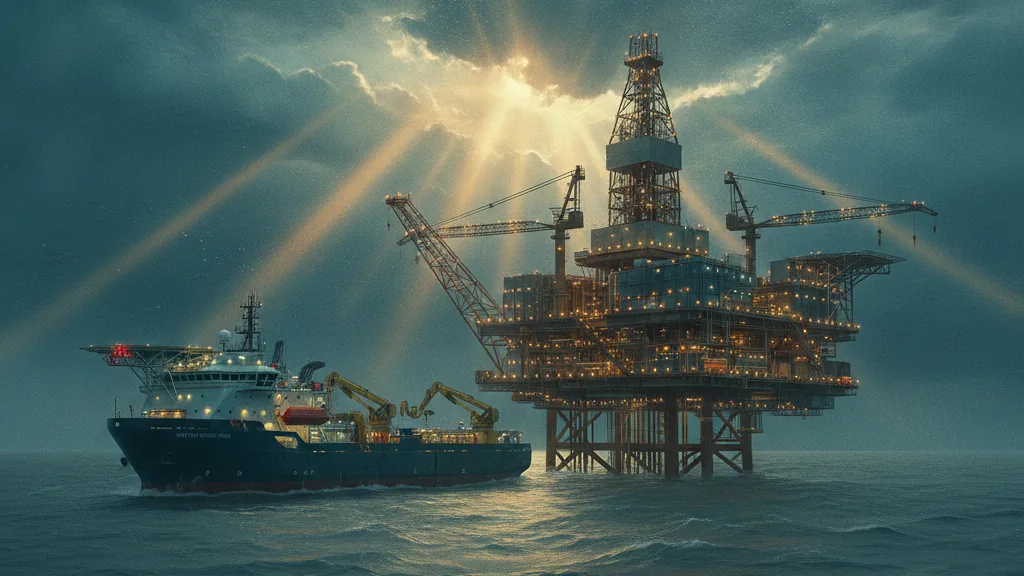
Photo: infomatique · CC BY-SA via Openverse