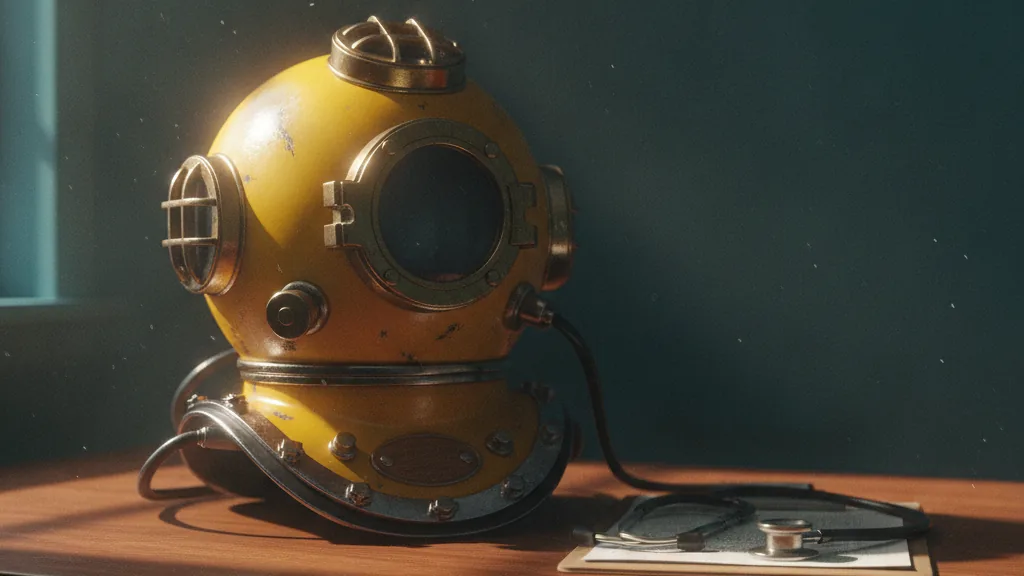
The commercial diving medical certificate is a fitness examination signed off by an authorised examining doctor (the AMED approved by the HSE in the United Kingdom). It assesses the heart, lungs, nervous system, ears and musculoskeletal system, and is renewed every year. Without a current certificate you can't enrol on a course or work as a commercial diver.
Before the helmet, the umbilical or any technical certification, there's one document that decides whether you can practise this trade at all: the commercial diving medical fitness certificate. It's the first requirement of the career, and also the one many hopefuls underestimate. This guide explains exactly what the examination assesses, who can sign it off, how often it's renewed, and why, without it, you simply don't work.
What the commercial diving medical certificate is
It's an official document certifying that a person is medically fit to work under pressure in a hyperbaric environment. It isn't a generic company check-up or a sport diving certificate: it's a specialised assessment aimed at the specific risks of commercial diving, such as decompression sickness, barotrauma, exposure to gases under pressure and physical exertion in adverse conditions.
That's why the examination follows specific guidelines and can only be carried out by personnel trained in diving medicine. The result isn't just "fit" or "unfit": it can also include restrictions (depth limits, say, or conditions to monitor) that are recorded on the certificate and that employers must respect when assigning you tasks.
Who can issue it: the examining doctor
The key thing is who signs it. Not just any doctor will do. In the United Kingdom, the examination is carried out by an Approved Medical Examiner of Divers (AMED), that is, an Approved Medical Examiner of Divers approved by the HSE (Health and Safety Executive), the UK's health and safety authority. These professionals are specifically accredited to assess fitness for commercial diving and issue the corresponding certificate.
Other countries have equivalent roles: doctors authorised by the national authority or recognised under international standards, such as those promoted by IMCA for the offshore industry. The principle is always the same: a doctor trained in hyperbaric medicine applying recognised criteria. Before booking your appointment, confirm the doctor is authorised for the market you'll be working in; a certificate signed by the wrong person won't do you any good. You can see how this requirement fits with the rest of your credentials in our guide to certifications.
What the medical examination assesses
The examination is more demanding than a routine check-up because it looks for any condition that raises the risk under pressure. Although the detail varies by country and applicable guidelines, these are the systems that are always checked.
Heart and cardiovascular system
The physical exertion of diving, the cold and the changes in pressure put the heart under strain. The examination checks blood pressure, rhythm and cardiac function, and usually includes an ECG. It looks for arrhythmias, murmurs or signs of coronary disease, because heart failure underwater is potentially fatal and hard to rescue.
Lungs and respiratory function
The lungs are critical: they handle gas under pressure, and any trapped air can cause serious barotrauma during ascent. Spirometry measures lung capacity and airflow, and the examination rules out uncontrolled asthma, a history of pneumothorax or other conditions that would complicate breathing under pressure.
Nervous system
The nervous system is one of the most sensitive to decompression sickness. The examination checks reflexes, strength, sensation, coordination and balance to establish a baseline and pick up any pre-existing deficit. Certain neurological conditions, such as some types of epilepsy, are generally incompatible with commercial diving.
Ears, nose and sinuses
Equalising pressure in the middle ear is a constant need underwater. The eardrums, hearing and sinus patency are checked, since equalisation problems can cause pain, vertigo or injury. Badly impaired hearing also affects communication with the supervisor.
Musculoskeletal system and general condition
Commercial diving is physical work: carrying gear, handling tools and holding against current. The doctor assesses mobility, strength and joints, pays attention to any history that might relate to dysbaric osteonecrosis, and checks general health, eyesight and, often, blood and urine tests. The aim is a full picture of your fitness for exertion in a hostile environment.
| Area assessed | Example tests |
|---|---|
| Cardiovascular | Blood pressure, ECG |
| Respiratoria | Spirometry, auscultation |
| Neurological | Reflexes, coordination, balance |
| Otorrino | Otoscopy, audiometry, sinuses |
| Musculoskeletal | Mobility, strength, joints |
| General | Eyesight, blood and urine tests |
How often it's renewed
The certificate doesn't last forever. Under frameworks such as the British one, the commercial diving fitness examination has validez anual: it has to be repeated every year with an authorised examining doctor to keep the certificate current. That frequency makes sense because health changes, and fitness has to be checked continuously throughout the career.
Besides the annual deadline, certain events can force an early review: a significant illness, surgery, a diving accident, or any problem affecting the areas assessed. In those cases, the right thing to do is to report it and be reassessed before diving again. Plan your renewal ahead of time so you don't end up without a valid certificate in the middle of a working season.
Why you don't work without it
The medical certificate isn't just advisable paperwork: it's mandatory. No serious company will take you on or let you dive without a current fitness certificate, for three reasons worth understanding properly.
- It's a legal and safety requirement. Commercial diving employment regulations require certified medical fitness. Working without it exposes both the diver and the company to serious liability.
- It affects insurance and cover. Without a current certificate you can find yourself outside cover in the event of an accident, which is not something you can afford to risk in a hazardous trade.
- It's the gateway into training. Most schools require the examination before you can enrol, precisely so they don't train someone who won't be able to work.
That's why, on the road to becoming a commercial diver, the medical examination comes first, even before choosing a course or school. It's the filter that decides whether the rest of the road is worth taking for you.
How to prepare for the examination
You can't "fake" health in a serious examination, but you can turn up in the best possible condition. Some sensible tips:
- Gather your medical history and bring reports of any prior condition, surgery or medication.
- Avoid alcohol and extreme exertion in the days before, so you don't skew your blood pressure or test results.
- If you wear glasses or contact lenses, bring them for the eyesight test.
- Be honest with the examining doctor: hiding your history is dangerous and can invalidate your fitness.
- Keep yourself in reasonable physical shape all year round, not just before the appointment.
Understanding what the commercial diving medical certificate assesses, and treating it with the seriousness it deserves, saves you scares and wasted time. It's the foundation the whole career is built on: look after your health, renew on time, and go into every examination without surprises. That first yes from the examining doctor is what opens the door to the rest of the trade.
Frequently asked questions
How often does the commercial diving medical certificate need renewing?
The commercial diving fitness examination is valid for one year under frameworks such as the United Kingdom's. You have to repeat it every year with an authorised examining doctor, and the certificate has to be current for you to work. Certain conditions or incidents can force an earlier review.
Who can sign a commercial diving medical certificate?
Only an authorised examining doctor. In the United Kingdom that's a doctor approved by the HSE (Approved Medical Examiner of Divers, AMED). Other countries have equivalent roles recognised by the national authority or by standards such as IMCA's. A GP without that accreditation cannot issue it.
What does the diving medical examination assess?
It checks the heart and cardiovascular system, lung and respiratory function, the nervous system, ears and sinuses, musculoskeletal health and general condition. It usually includes an ECG, spirometry, hearing tests and blood work, because pressure and gases demand far more of the body than work on land does.
Can I work if my medical certificate has expired?
No. Without a current fitness certificate you can't dive professionally, and no serious company will hire you, because it's a legal and safety requirement. Working with an expired certificate puts you outside cover and insurance, as well as putting your health at risk.
What can lead to being declared unfit?
Heart problems, lung disease, certain neurological conditions, ear conditions that prevent equalisation, or any condition that raises the risk under pressure can result in a finding of unfitness or in restrictions. The decision is made by the examining doctor according to the current guidelines and the specific case.
Published 10 August 2026 · satdiver.com

Photo: SFU - Communications & Marketing · CC BY via Openverse
This article is part of our in-depth guide to commercial diving certification: HSE, IMCA, ADCI, ADAS and DCBC — the complete picture, with sources.
This article is part of our in-depth guide to commercial diving certification: HSE, IMCA, ADCI, ADAS and DCBC — the complete picture, with sources.
This article is part of our in-depth guide to commercial diving certification: HSE, IMCA, ADCI, ADAS and DCBC — the complete picture, with sources.
This article is part of our in-depth guide to commercial diving certification: HSE, IMCA, ADCI, ADAS and DCBC — the complete picture, with sources.