A pressurised diver cannot get out: decompression takes days. So the response to a medical emergency is organised inside the system, with the life support technician and teammates as first responders, a pressurised medical kit, advice from a hyperbaric doctor on permanent call and, if it is unavoidable, an emergency decompression or evacuation in a hyperbaric rescue capsule.
It is the question everyone asks on hearing about the trade: what if something happens to someone in there? The short answer is that the system is designed on the assumption that it will happen at some point, and that there is no quick way out. The long answer explains rather well how safety works in this industry.
If you are not clear on the starting point, it is worth reading first what a saturation diver is y what life is like inside the chamber.
The underlying problem: there is no door
A saturated person's tissues are loaded with inert gas dissolved at working pressure. Opening the system or reducing the pressure quickly would cause severe, potentially fatal decompression sickness. Scheduled decompression takes days, and its pace cannot simply be sped up.
That turns any medical problem into an isolation problem, closer to medicine in Antarctica or on a spacecraft than to an emergency on a building site. The strategy is not to evacuate quickly: it is to treat inside.
The first line: the people already inside
The divers themselves are trained in first aid, and many hold advanced medical qualifications. Inside the chamber, a teammate carries out the initial assessment, applies the indicated treatment and acts as the hands of the doctor outside.
The link between inside and outside is the life support technician, the person who watches the system around the clock and coordinates the response from the panel. Their role in an emergency is as important as the clinical one, because they control the atmosphere, the temperature and any pressure adjustment that is decided on. Their job is described in what a life support technician does.
The system carries a pressurised medical kit on board, with medication and supplies loaded in beforehand, and a medical lock that lets drugs, fluids or instruments be passed through without opening the system. Practically everything needed can go in that way.
The remote hyperbaric doctor
Saturation operations work with permanent access to a doctor specialising in hyperbaric and diving medicine, available on continuous communication. This is not a generic on-call service: it is a professional who understands how the body behaves under pressure and how drugs and procedures change in that situation.
That detail matters more than it seems. Under pressure, some routine techniques get complicated: managing the airway, giving fluids or reading clinical signs all need adapting. A treatment that is correct at the surface may not be correct at saturation pressure, which is why decisions are made with specialist advice rather than improvised judgement.
What can be dealt with inside
Most medical problems during a campaign are, fortunately, minor: outer ear infections, skin problems, muscle pain, dental trouble, digestive upsets. The warm, humid environment favours exactly those conditions, and the system is set up to treat them without interrupting the operation.
That is why the pre-employment medical is so demanding, and why things that would seem irrelevant in another job get checked, such as dental condition or respiratory history: the aim is to reduce the chance of something foreseeable turning into an emergency in a place you cannot leave. That exam is covered in detail in the commercial diving medical certificate.
When the diver has to come out
If the condition is serious and needs care that cannot be given inside, two routes remain, neither of them immediate.
The first is an accelerated decompression, within whatever margins the doctor considers acceptable. It still takes time and carries added decompression risk, so the decision weighs that risk against the risk of not treating.
The second is pressurised evacuation. Saturation systems include a hyperbaric rescue capsule, a self-contained chamber able to hold the divers under pressure and be transferred to another vessel or ashore, where it connects to a receiving facility to complete decompression there. Its main purpose is to allow a vessel in danger to be abandoned without decompressing, and having one is one of the requirements in the industry's codes of practice.
It is a last resort, complex to activate, and it requires coordination between the vessel, the operator and the receiving facilities ashore. Its value lies in the fact that it exists and is drilled, not that it is used often.
The scenario drilled most
Beyond illness, the classic critical scenario is a diver accident in the water: loss of gas supply, entrapment, injury during the job. There the response starts with the bellman, the teammate who waits in the bell precisely so he can go out and recover an incapacitated diver and bring him back inside.
That rescue is drilled systematically, and it is one of the reasons for the three-diver team set-up. The chain continues with recovering the bell, transferring to the system and treating the diver inside, with the same remote medical advice set-up.
All this is part of the honest risk assessment of the trade that we cover in is saturation diving dangerous and of the standards promoted by the contractors' association described in what IMCA is.
What a would-be diver should take away
Three things. That the isolation is real and is not solved with good intentions but with preparation beforehand: that is why the medical standard is high and why no shortcuts are allowed. That first-aid training is not a formality, because inside the chamber, the nearest medic is you. And that safety in this trade rests less on luck than on written procedures, redundant equipment and people trained for scenarios that almost never happen.
If you are considering the path, the training route is set out in how to become a commercial diver and the certification requirements in certifications.
Preparation beforehand: what prevents the emergency
The least visible part of this system is the part that acts before anything happens. It starts with the annual medical selection, continues with the dental check-up, updating vaccinations and declaring any regular medication, and goes on with a review of medical history before a long campaign.
On board, prevention comes down to everyday details: strict hygiene, careful ear drying, controlling the temperature and humidity of the chambers, cleaning the system between campaigns and watching for any minor symptom. In a closed environment, a small problem caught late becomes a big one.
Divers learn to report discomfort that would be shrugged off ashore. That is not hypochondria: it is the sensible thing to do when the alternative is getting worse in a place you cannot leave.
The psychological factor
Alongside the strictly clinical side is the mental one. Prolonged isolation, lack of privacy, noise and disrupted sleep can wear anyone down, and an anxiety crisis inside a pressurised chamber is a real medical situation, not a matter of character.
The usual response combines the same tools: support from teammates, communication with the outside, remote professional advice and, if needed, adjusting the workload. The prior selection and training aim to reduce the chance of getting to that point.
It is one of the reasons this trade is not recommended for anyone chasing the high pay alone without weighing up the confinement. It is worth reading carefully what life is like inside the chamber before deciding.
Frequently asked questions
Can a diver be brought out of the saturation chamber quickly?
No. The tissues are loaded with inert gas at working pressure, and reducing the pressure quickly would cause severe decompression sickness. Scheduled decompression takes days and can only be sped up within limited margins and under medical judgement.
Who looks after a sick diver inside the system?
First their own teammates, trained in first aid, and the life support technician from the control panel. Clinical guidance comes from a doctor specialising in hyperbaric medicine, available on permanent communication.
How does medication get into the chamber?
Through a medical lock, a small intermediate chamber that is pressurised to transfer items without opening the system. The system also keeps a pressurised medical kit on board, with supplies and drugs for the most likely situations.
What is a hyperbaric rescue capsule?
It is a self-contained chamber that allows the divers to be evacuated while keeping them under pressure if the vessel has to be abandoned. It is transferred to another vessel or ashore and connects to a receiving facility where decompression is completed.
What medical problems are most common in saturation?
Minor ones: outer ear infections, skin problems, dental trouble, muscle pain and digestive upsets. The system's warm, humid environment particularly favours ear and skin infections.
Why is the pre-employment medical so strict?
Because there is no quick evacuation from inside the system. The exam aims to reduce the chance of a foreseeable condition, including dental or respiratory health, turning into an emergency in an environment you cannot leave within hours.
Published 22 August 2026 · By Arthur More, professional saturation diver
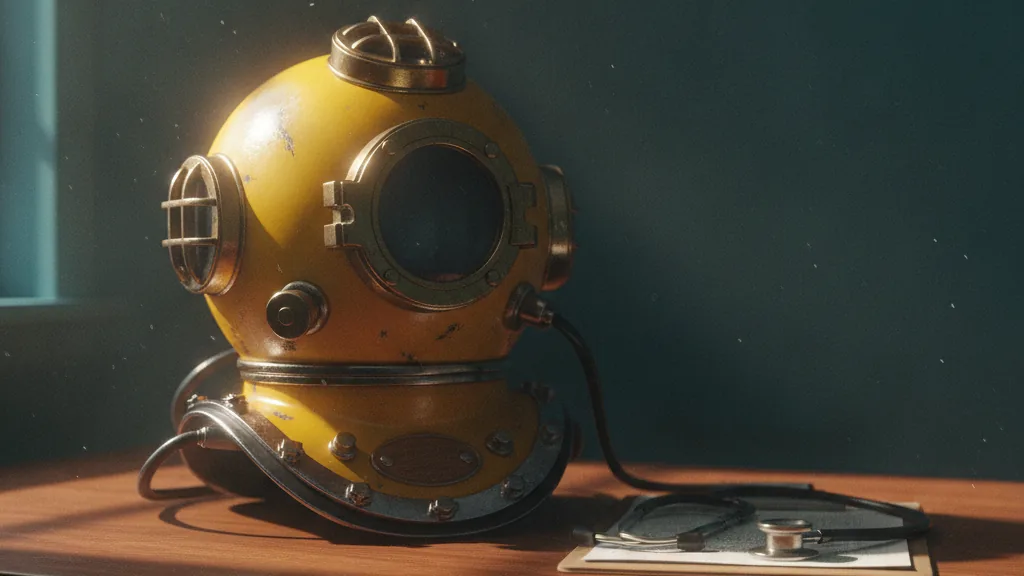


Photo: infomatique · CC BY-SA via Openverse
This article is part of our in-depth guide to commercial diver requirements: the medical, eyesight and age limit — the complete picture, with sources.
This article is part of our in-depth guide to commercial diver requirements: the medical, eyesight and age limit — the complete picture, with sources.
This article is part of our in-depth guide to commercial diver requirements: the medical, eyesight and age limit — the complete picture, with sources.
This article is part of our in-depth guide to commercial diver requirements: the medical, eyesight and age limit — the complete picture, with sources.